Back to Blogs
WHITEPAPER: Why Variable Renewable Energy Makes Flexible Industrial Heat Storage More Valuable - and Vice Versa

Hayden Smith
September 16, 2026
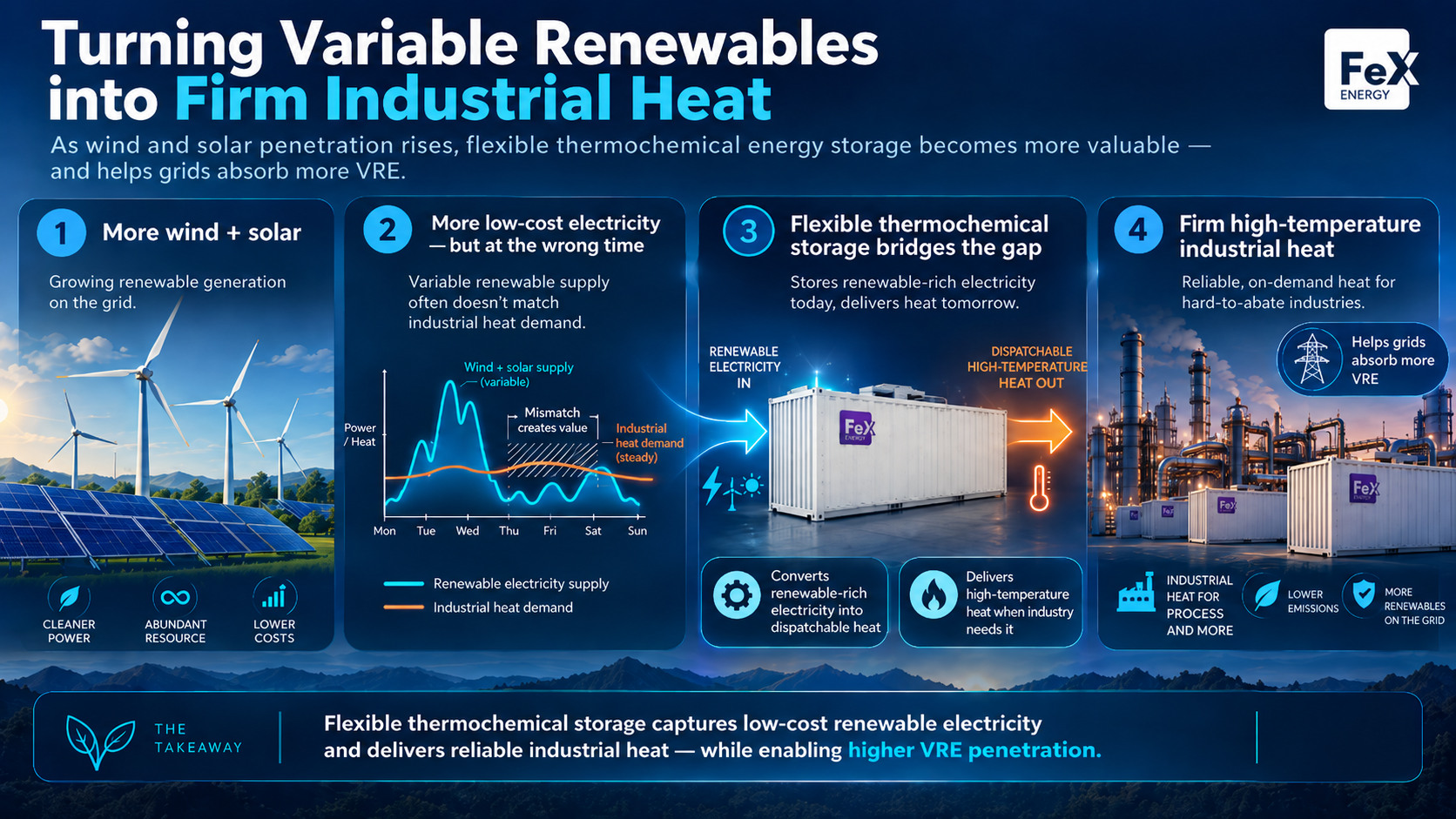
As wind and solar penetration rises, the gap between when low-cost electricity is available and when industry needs heat is becoming more important.
Our new white paper explores how flexible thermochemical energy storage can bridge that gap—turning renewable-rich electricity into firm, high-temperature industrial heat while helping grids absorb more VRE.
Click here to receive a free copy of the white paper and learn more.
Executive summary
The industrial decarbonization problem is not simply how to make heat electric. It is how to supply firm, high-temperature heat when the lowest-costelectricity increasingly arrives in variable, weather-driven windows. Wind andsolar are expanding quickly: the International Energy Agency (IEA) forecasts wind and solar to rise from 30% of European Union electricity generation in2025 to 46% in 2030; globally, from 17% to 27%; in China from 22% to 37%; andin India from 14% to 24%.
That transition increases the value oftemporal flexibility. High variable renewable energy (VRE) systems already experience periods in which renewable output is abundant relative to demand,followed by scarcity periods when output falls. The resulting signals includerenewable curtailment, falling wind and solar capture rates, negative-price hours and large intraday price spreads. In the first half of 2026, negativewholesale prices occurred during about 17% of hours in Spain and around 20% inSouth Australia and California; during European heatwaves in June, midday-to-evening price spreads reached as much as USD 600/MWh in severalmarkets.
FeX is designed around this mismatch. Its thermochemical storage architecture separates the timing of the electricity-intensive charging step from the timing of heat delivery. A plant can therefore continue to operate on its production schedule while the storagesystem responds to electricity availability and price - without asking the process to follow the weather, and without forcing the site to run a large electrical heater through the most expensive system or tariff peaks. Exposure to peak-demand or capacity charges remains tariff-specific, but flexible charging creates a tool to manage it.
Core thesis
More VRE makes flexible energy storage assets, like FeX’s, more valuable because it increases the economic value of shifting electricity through time. FeX, in turn, can make more VRE economically usable by converting firm industrial heat demand into a controllable electrical load. The business case is therefore reciprocal, not unidirectional.
Article by
Hayden Smith
Hayden Smith is CEO of FeX Energy, where he leads the company’s strategy, investor relations, and business development. He is focused on scaling FeX’s iron-based thermochemical energy storage technology to deliver reliable, high-temperature industrial heat and accelerate the electrification of hard-to-abate sectors.
Share on


Recent Posts
September 16, 2026
WHITEPAPER: Why Variable Renewable Energy Makes Flexible Industrial Heat Storage More Valuable - and Vice Versa
How flexible thermochemical energy storage turns variable renewable electricity into firm, high-temperature industrial heat.
Hayden Smith
June 2, 2026
Earthlings 2.0 Podcast: Can Renewable Energy Replace Combustion?
🎧 Listen now: #163 - Can Renewable Energy Replace Combustion? This Company Thinks It Can With FeX Energy - Earthlings Podcast

FeX Energy
March 13, 2026
Why many industrial electrification projects hit the grid limit
Electrifying industrial heat is often framed as a question of energy supply. But in many real projects, the first constraint shows up somewhere else entirely. Electrical infrastructure.

Sebastian Lanfranco

Iron-based energy storage delivering firm heat and power on demand.