Back to Blogs
Rust took their water. A different rust brought it back.

Artemisa Forbes
October 29, 2026
Blue Subsurface | October 2026 | A conversation with Hayden Smith, CEO of FeX Energy, on the iron reactor he designed for the Arctic's diesel problem, and why its first customers will be factories in Western Europe.
On October 12, 2021, the City of Iqaluit declared a state of emergency and told its residents that the tap water was unsafe to drink, even filtered, even boiled. Complaints about a smell of fuel coming out of the taps had been arriving for days. Two weeks later the city's chief administrative officer, Amy Elgersma, told CBC/Radio-Canada what the crews had found: a "suspended tank" that had "rusted out," sitting in an inaccessible void between the water treatment plant and the blasted bedrock beneath it. It might date from the 1960s, she said, a rough estimate. Nobody at the city could say what it had been for. Fuel from it had reached the plant's north tank.
For the next 59 days, nearly 8,000 people in the capital of Nunavut lined up for bottled water outside Nakasuk School, filled containers at the Sylvia Grinnell River until it began to freeze, and drew from reverse-osmosis units sent in by the Canadian Armed Forces. WSP, the engineering firm brought in by the city, cut the contamination pathway on October 24, removed the old tank and cleaned the void. Nunavut's Department of Health lifted the do-not-consume order on December 10.
The tank was the unusual part but the fuel was not. The Canada Energy Regulator counts about 178 remote Indigenous and northern communities that are connected to neither the North American grid nor the gas network, more than half of them fly-in only. Nearly all of them run on diesel for electricity and heat. It arrives by truck on winter roads, by barge in the few weeks the water is open, or by plane, and it waits in above-ground tank farms. In the regulator's words, it "can leak or spill in storage, during transport, and from home tanks." The Northwest Territories and Nunavut recorded roughly 437 contaminant spills in 2024, 56 percent of them in Nunavut.
Hayden Smith spent close to twenty years building gas turbines at Rolls-Royce and Siemens Energy, the machines that burn fuel to make power. In 2023 he co-founded FeX Energy in Montreal, out of McGill University's Alternative Fuels Laboratory, to build something that sounds wrong the first time you hear it: a shipping container of iron that stores electricity and gives it back as heat, hot enough to run a factory, with nothing burning. He designed it for the geography above. Canada's Department of National Defence awarded the company a $1 million prize for it in July 2025, and a US$3.5 million seed round closed in September.
Then he decided that his first customers would be factories in Western Europe.
The numbers behind that decision are not Canadian. On October 16, the Dutch TTF gas benchmark traded at US$28.9 per million BTU against US$3.1 at Henry Hub, roughly nine times the American price, with Qatar's LNG exports still under force majeure eight months into the war with Iran and EU gas storage about 16 points below its five-year average going into winter. EU carbon allowances touched €88 a tonne on October 12. And on September 24, the European Commission published the final terms of a €1 billion auction, opening to bidders in early December, that will pay industrial plants a fixed premium for every tonne of CO2 they keep out of the air by taking their process heat off fossil fuels. Thermal storage is explicitly eligible. A mine in Nunavut, burning diesel at the end of an ice road, pays none of that.
We spoke on video for about forty minutes. The conversation below has been edited for length and clarity. FeX's performance figures are the company's own until its pilot reports, and I have said so where it matters.
From gas turbines to rust
You spent almost twenty years at Siemens and Rolls-Royce building gas turbines. Then you walked away from all of that and started a company about rust. How did that happen?
(Hayden) You have to go back to the origins. In my late teens I started thinking about what I could do to make the world a better place. I loved Lego and technology and building things, so I became an engineer. My father was an entrepreneur and my grandfather as well, so business ran through my blood too, and I wanted to use business as a vehicle to create positive impact. I cared about climate. I started at Rolls-Royce, then Siemens and Siemens Energy, and I did all the cool corporate things. And through all of it I realised I wasn't fulfilling that purpose.
I was in senior management, and I didn't like a corporate culture that suppressed human capability. The way I led was very different. Somehow it worked, and I got promoted for it, and then I was in a pool of people at a senior level who all expected you to lead the way they led. So mid-career I stepped down from a senior leadership position and started doing culture transformation. We said, let's make this a company worth working for. My team and I embarked on a multi-year transformation, and 500 people in, there was a reorganisation. A lot of good came out of it, but it certainly wasn't transforming 380,000 people in their way of working.
That's when Siemens Energy Ventures came about: small speedboats at the edge of the company that could create new business and new impact. We created twenty or so ventures. But that too was slow. Not enough. There was a desire to go bigger and faster, at least in my heart, that the organisation wasn't ready to fully back. I had always believed small teams are how you change the world, and that you could build them inside a corporation, with its brand and know-how and manufacturing and presence all over the world behind them. Then I realised the corporation and its culture prevent those teams from being fully successful. So I said, let me go build one of those little teams outside.
I didn't know what I was going to do. I had a thesis around energy storage. We've already made renewable generation the cheapest and cleanest way of making power; it's just intermittent. Storage is how you turn very cheap renewables into firm energy. For that you need materials that are abundant, long duration, reasonable density, and economics that work.
Then it was pure synchronicity. I met my co-founder, Marc Guilbert, in a coffee shop. He had exited another startup and raised some money to deploy into promising clean technologies stuck in university labs. His thesis was that Canada spends billions on research at technology readiness levels two to four in universities, and then there's a valley of death between those projects and actual companies. He had found 200 technologies. I asked him what the top one was. He said an iron energy storage technology. I said, is that out of McGill? Is that Jeff Bergthorson? Because at Siemens Energy Ventures we had invested in another technology out of the same lab, a metal fuel idea that a colleague of mine, Michael Johnson, had pushed forward through our programme. So there was already a two or three year relationship with Jeff. I showed up at his lab with Marc, and he said, what the heck are you doing here? And I said, I don't know, maybe there's a company to be started between us. Three and a half years later, Jeff, Marc and I are co-founders.
Rusting and unrusting
Explain it to me like I'm your neighbour. How do you store electricity in a pile of iron, and how do you get the heat back out?
(Hayden) Einstein said that if you can't explain something in a minute to a five-year-old, you don't really understand it. My eight-year-old, Mika, understands what we do. He'd probably explain it better than I do.
Fundamentally, we're rusting and unrusting iron. When iron rusts, it releases energy. Rust, which is iron oxide, sits at a lower energy state than iron, so when you rust it you release heat. It's exothermic. Charging is the reverse: reduction. You pull the oxide off the iron. So picture the iron atom, and oxygen coming in and attaching to it. Energy goes out. Pull the oxygen back off, and energy goes in. That's all we're doing.
You move the oxide in and out with gases. Flow air over the iron at the right conditions and the oxide attaches, and you get the heat. To charge it, you use another gas, hydrogen, which pulls the oxide off.
The simple analogy is your car sitting in the driveway. In Canada we have a lot of rusty cars. My Tesla is an example, which is sad, because it's only five years old. When the car rusts, it is releasing heat, very, very slowly. If you could make that happen fast, and capture the heat and use it, that's basically what we're doing. Take the car, crush it into the right kind of material, oxidise it quickly, and you get the energy out.
Built for the cold
You started building this for the Canadian Arctic. Now your first customers will be factories in Europe. What happened?
(Hayden) First, the genesis story. The technology stores electricity and outputs heat. So the question we asked in the early days of the company was: where do you need heat, and where is electricity very expensive? If the electricity you use today is very expensive, and you could make it from renewables and output heat from our product, you solve a pretty big problem: the cost of the energy, the need for the heat, and the logistics of getting energy to the North, which is all diesel. Almost the entire North, whether it's the remote communities, the few dozen remote mine sites or the few dozen remote military installations, runs on diesel. Diesel is very expensive, and it's complex to get there. You ship it through routes that are open for a few weeks a year and then freeze over, or on ice roads that are also only available for a few weeks a year. So we said, let's build this for the Arctic and provide heat in the coldest parts of the world in the winter.
The Department of National Defence is very interested. We're still exploring and working with them. We want a grant under the NORAD modernisation project to look at how you'd modernise the whole northern defence apparatus, and it's still proceeding. But it's slow, and it's small, relatively speaking.
The ambition of the company was always: how do you change the world? How do you leave a better world for our children? If you displace the diesel of a few hundred operating facilities in the North, you do absolutely nothing in terms of changing the carbon footprint of the planet. Even if you did it in every allied nation, it would be a drop in the ocean. It's a good starting point. And for me it's personal. My family were in the military. My great-grandfather, an immigrant to Canada in the late 1800s, joined the Canadian Expeditionary Force in the First World War. He was cold and alone on the front lines in France. I felt it was very important to help the people defending our country against threats that are real, and give them a little bit of warmth in the coldest days of the year.
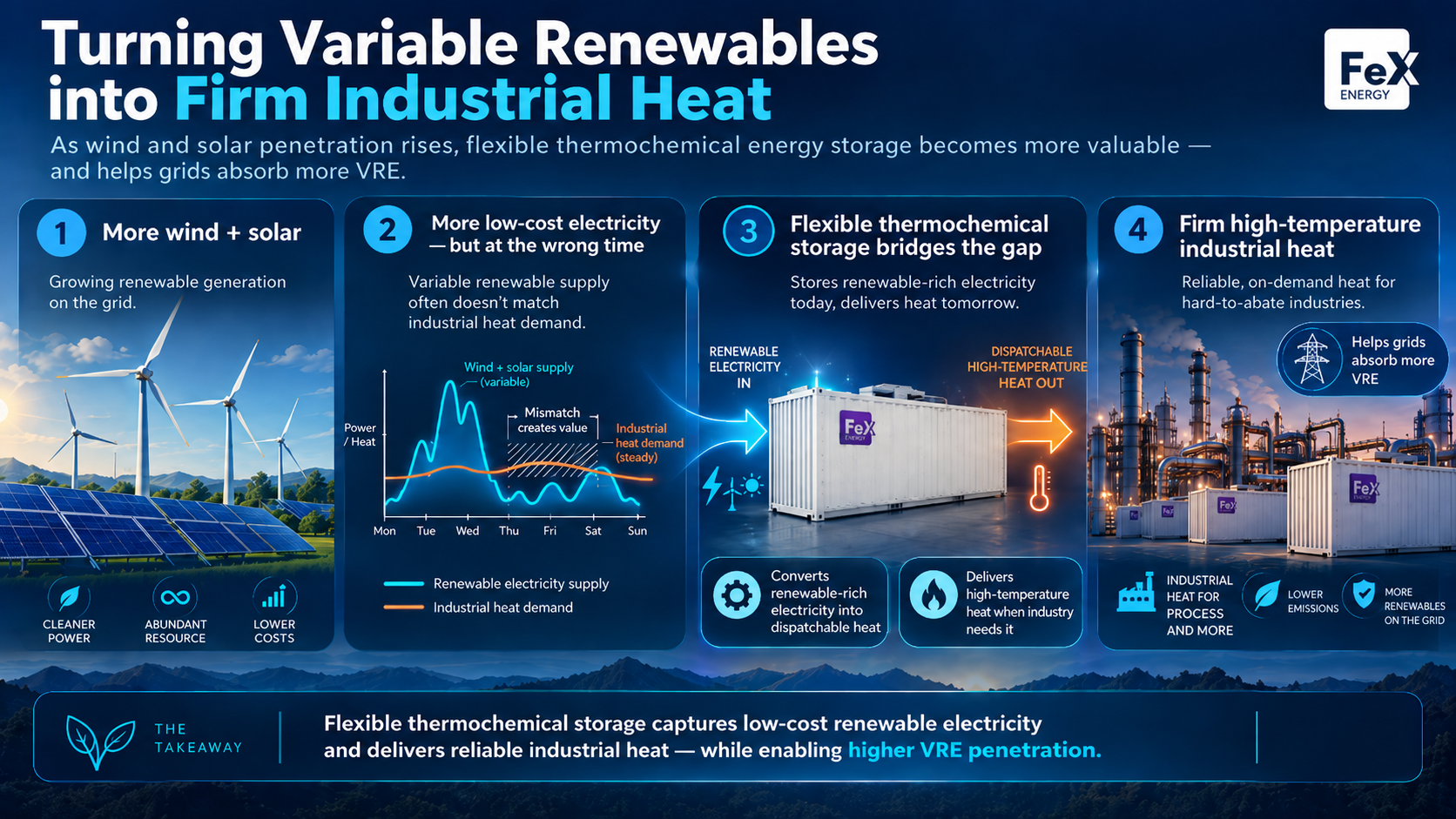
But the bigger picture needs greater outcomes: greater pathways to carbon abatement, and displacing natural gas as a fuel, primarily. That's how the European thing came to be. We asked: where else is fuel expensive? And where is there already renewable energy that you can take advantage of and turn into firm heat for industry? The answer is Western Europe, in countries with high renewable penetration. Since the Ukraine and Iran wars, fuel costs have skyrocketed. Industrial producers are trying to stay profitable amid growing fuel costs, and at the same time renewable penetration is growing: above 30 percent on average now, 70 percent or more in some places, and planned to reach 70 percent on average by 2035. To get to those shares, you need storage to firm the grid, and in industrial heat, which is about 20 percent of final energy use, it's no different. The cheapest way to make that heat from clean energy is with the lowest-cost energy you can get, which is variable renewables. But the need for heat is constant. So you need a way of firming it.
The play is to make the cost of heat the same as or lower than natural gas, but from clean electricity. For the industrial end user, it's a play on keeping costs down. It's a hedge: I'm going to get the lowest possible cost for my heat, to keep production profitable for many, many years to come. The side effect, which in my mind is the primary objective, is that carbon emissions fall as a result.
"For the industrial end user, it's a hedge. The side effect, which in my mind is the primary objective, is that carbon emissions fall."
(The renewable shares and the industrial heat figure above are Hayden's numbers. A note on the European market, and on who is already in it, follows the interview.)
The first customers
What do these first customers look like? What are they making, and what are they burning today?
(Hayden) Industrial processes below 900 degrees Celsius, which will be the peak output temperature of our product. That's chemicals, food and beverage, pulp and paper, and into petrochemicals and oil and gas as well. By our count, about 60 percent of final heat use, which is about 12 percent of total final energy use, is below 900 degrees, and that's what we can address. The foods we eat, the paper we write on, the boxes our Amazon orders arrive in, the plastics almost everything is made of these days: all of it needs a tremendous amount of heat, and that heat is mostly made by burning natural gas. In some cases there's still coal, which is really dirty.
It creates sovereignty questions too. With the Strait of Hormuz closing, East Asia and a lot of Europe are at a bit of a loss. How are we going to get these imported fuels? Having local sources of energy is critical for sustaining your country. Europe is on a path to find ways of doing that. Canada is too. And from my perspective, the best way is to capture the energy that's falling all around you most of the time, the sun and the wind, and make it firm through storage.
Factories in Europe must already be using some form of heat storage. What does iron do differently?
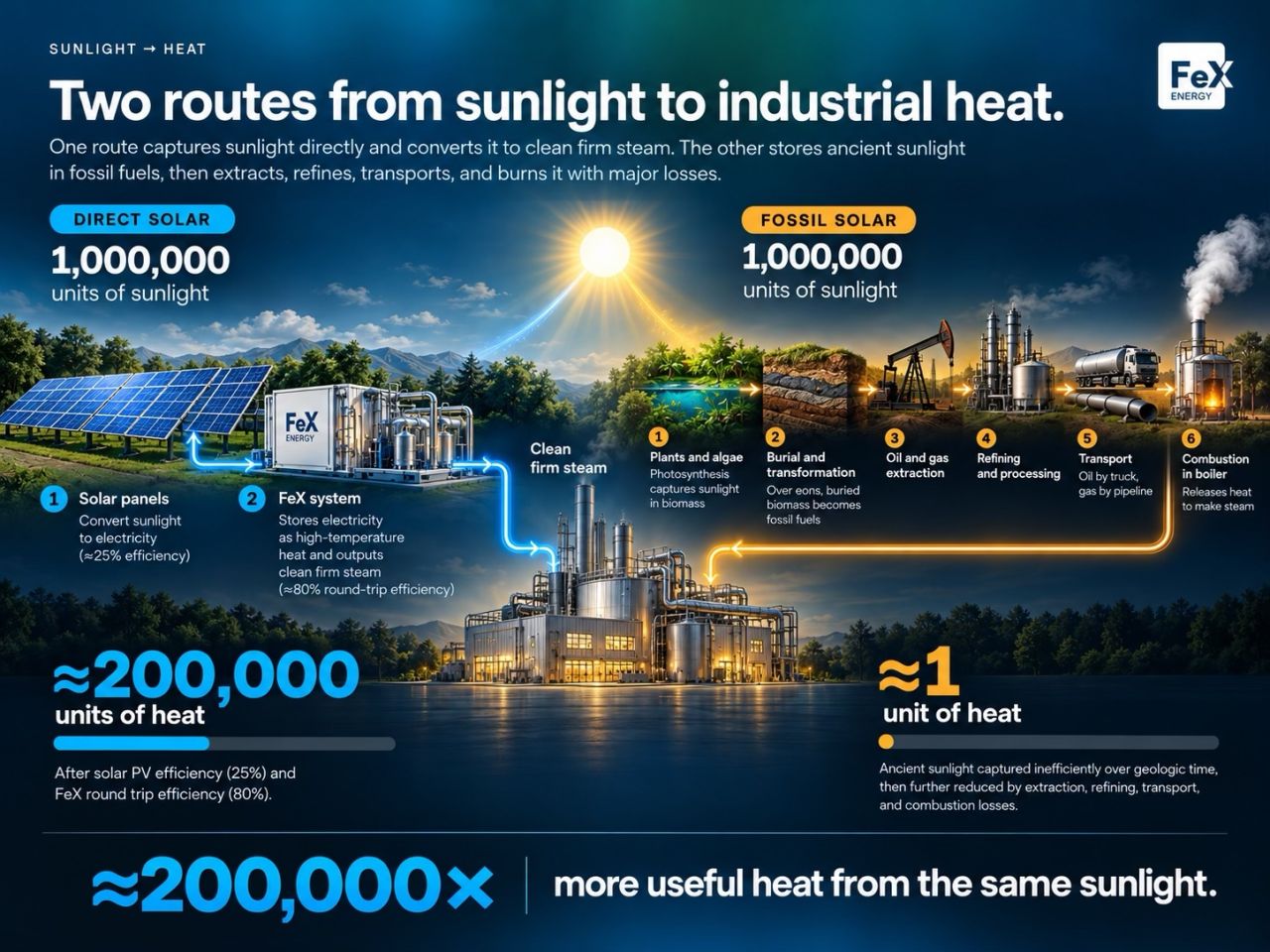
Most companies don't use any form of storage. The storage is the fossil fuel. Think about where the energy in fossil fuels came from. You can't create or destroy energy, only change its state. It came from the sun: solar energy captured in plants and animals that died eons ago and were turned into hydrocarbons by the pressure and the temperatures of the earth. About 150 years ago people drilled holes, oil came out, and they thought, this is an abundant resource we can just burn. Nobody knew until a few decades ago that burning it produces CO2, a greenhouse gas that roasts the planet.
So the solution is: don't store the energy in fossil fuels, which takes eons to form, then a whole lot of extractive work and destruction of the earth, and all kinds of outputs that need to be remediated and cleaned up, and then refining, shipping, borders, and all the geopolitics around it. Go back to the sun hitting the place where the energy is needed, and make the heat there. Isn't that so much more straightforward? Haven't we been doing it wrong from day one? A solar panel captures something like 30 percent of the sun's energy, and storing it at an 80 percent round trip leaves you with about a quarter of what arrived. Against the fossil chain, it's a no-brainer. We've been wasteful and complex for no reason.
Change is hard. We could talk for a long time about how change happens. But I believe it will happen, because fundamentally people are smart, and eventually the solutions that were built into the planet from its inception are the ones that will prevail.
The tank beside the water plant
In 2021, Iqaluit couldn't drink its tap water for two months because an old fuel tank beside the water plant had rusted through. Is that something you have been thinking about solving?
(Hayden) Absolutely. You're double-clicking on the diesel. The tank that rusted through in that story: diesel is corrosive. It goes stale after a while and has to be replaced, and then where do you put it once it's no longer useful? It can leak. It's a liquid that leaches and leaks into the ground. Diesel is nasty. You don't want to be using it if you can avoid it.
But it has been the best solution the North has had. If you don't have diesel, you don't have electricity or heat, and without those you can't really survive, let alone have a life where you can learn, advance, teach your children. Energy is the lifeblood of progress and prosperity, and even dignity. So it makes sense that diesel has been used for such a long time. With the falling cost of renewables, you can now capture solar or wind for a similar price to the diesel. And once you replace the diesel, you eliminate all of those issues. You don't have leaky tanks, you don't have spills, you don't have ground contamination, you don't have water contamination, you don't have noise, you don't have particulate emissions, you don't have carbon dioxide. And with water specifically: if you contaminate the water, you can't really uncontaminate it in the North. Now you have no water to drink. What do you do? It becomes very, very difficult.
Indigenous communities are active in looking at alternatives. Many have installed solar panels. Believe it or not, the North has the best solar profile in the world for half the year, and the worst for the other half. In the summer, pretty much all of your electricity could come from solar. In the middle of December, none of it. So a lot of communities are installing solar for summer electricity, and that displaces quite a lot of diesel, which is great. The missing piece is storing that solar or wind energy so that you can displace the diesel in the winter too. That's what our solution aims to do.
Energy can solve everything, by the way. If you had enough energy, you could clean the water as well: run it through filters, desalinate it. The energy is the major cost and the major input that makes water clean.
"If you contaminate the water, you can't really uncontaminate it in the North."
Why not batteries
A silly question: can batteries simply solve the storage problem? What is the difference between iron and a battery?
(Hayden) The challenge is duration. The sun and the wind don't shine and blow all the time, so you need storage for longer than a couple of hours: days, maybe weeks. That's the challenge with batteries. Lithium-ion has fallen more than 90 percent in cost over the last decade and a half, which is incredible, the same exponential curve as solar and wind. But there's a floor. People expect lithium-ion to bottom out at around 75 dollars a kilowatt-hour of capital cost, maybe a little lower. When I started in this industry twenty years ago, batteries were around a thousand dollars a kilowatt-hour, and not even one hour of storage was economic. Now that the cost has fallen by a factor of more than ten, you can afford longer duration. But it tops out at around six to eight hours, depending on the project. That's not long enough to bridge the sun's absence for half a day, or the wind's absence for several days, or the gap between sun in the summer and no sun in the winter.
Our solution is established for a very low marginal cost of storage, 25 to 30 dollars a kilowatt-hour, which can take you to 100 hours or more. It's an economics game: the cheaper the storage, the longer you can afford to store. And because the energy is stored chemically, the unit is much smaller than storing the same heat by just heating material up. It also decouples charging from discharging. There are no losses in between. If the wind doesn't blow for three or four days and then blows abundantly three weeks later, you can shift across that.
(Editor's note: BloombergNEF's December 2025 survey put average lithium-ion pack prices at US$108 per kilowatt-hour, 93 percent below 2010, and stationary storage packs at US$70, already under the floor Hayden describes. The duration argument does not depend on that floor. The cost comparison does, and FeX's 25 to 30 dollars is a company target, not a delivered price.)
What is actually running
Where is the technology really at today? What is running, and what is still on paper?
(Hayden) We're making progress. When we started the company in 2023, the technology was at TRL 3. We've taken it through lab-scale demonstration and we're finishing a pilot. The pilot unit is 100 kilowatts, and it's going to demonstrate that we can provide heat through a winter for three buildings on a campus in Ottawa. It shows the integrated system, not just the storage but the charge and the discharge, delivering heat to the campus. It will displace high-cost daytime electricity with low-cost, clean night-time electricity, and offset the oil and gas burned to heat those buildings. That's the first proof point of the technology, and of commercial value for a customer.
We're actively working on letters of intent with customers in industrial heat, one chemical company and one food and beverage company, to demonstrate commercial viability at a larger scale, a megawatt or thereabouts. Then the intent is to scale to multi-megawatt projects and take multiple projects a year in the years after the first commercial deployment, which is in the next couple of years. We're at the beginning of that inflection point, gearing up to manufacture the product at a larger scale.
(The campus is Natural Resources Canada's CanmetENERGY site, according to FeX's July 2025 announcement, which set the pilot's target at technology readiness level 7.)
Where is the company in five to ten years?
My hope for the company in ten years is that it's on its way to abating millions of tonnes of CO2 a year. That takes tens, then hundreds of megawatts deployed, and our ambition is to get into the gigawatt range of annual production, and from there into hundreds of megatonnes of carbon abatement a year: through Europe first, then East Asia, and eventually North America, where the economics work. For the producer, the carbon is the secondary benefit. For our company it's the primary interest. But our other primary interest is the customer: a solution that's economically viable and helps them do business more profitably. It's a dual bottom line, a win for the planet and a win for the customer, at a scale that moves the needle.
Don't let them get you down
You mentioned change earlier, and who to talk to about it. I work in communications, so I have to ask: how do you cause change?
(Hayden) My dad's a lawyer. When I was a kid he had a little figurine: a tired old lawyer in his suit and the fake wig, sitting on a pile of law books, and at the bottom it said, "Don't let the bastards get you down." One of his lawyer friends gave it to him when he hit a milestone. That has stuck with me since I was a little kid, and I'd say it's the essence of how you change the world. It sounds crude, and the flip side of it is the real point.
The law of diffusion of innovation says you always start with the initiators of change. Every domain is a normal distribution. Most people will adopt a new solution eventually. Some will adopt it once everyone else has. A few are naysayers, and they're not wrong; it's your great-grandmother who will never get a cell phone, and that's fine. On the other side are the initiators, the people trying to put the message out, and the early adopters who hear it and say, that's cool, I want to do that. Those are the ones you talk to. You only need to reach ten or fifteen percent of the population for the early adopters to tip the scale and transform the whole thing. Malcolm Gladwell wrote about it in The Tipping Point.
When I was leading culture change at Siemens, it was very easy to get into dances with the people who say, you're an idiot, that makes no sense, I'll never do that. Your ego acts up. You say, let me prove it to you. And you can waste all your energy and they won't be convinced. So go find the person who needs the cell phone, who's dying for a way to get in touch with their relatives. Start there. When you hit that tipping point, you don't have to do much; it takes off by itself. That's how we did it at Siemens. We were a team of ten, and 500 people were working the new way. We didn't convince every one of them. They got excited and jumped on board.
That's where we are now. We're the initiators. We have a couple of initiator partners around us. We're looking for the early adopters.
"You only need to reach ten or fifteen percent for the early adopters to tip the scale. Never focus on the laggards."
And if someone wants to reach you?
(Hayden) Email me directly: hayden.smith@fexenergy.com. If you're interested in changing the world for the better and you think you can help, or that I can help you, reach out. I'm happy to have a conversation. Just please don't spam me with things that aren't relevant.
What is claimed, and what is on the ground
A few things the conversation does not settle, for the reader who has to make decisions.
FeX has not delivered a commercial unit. The 100 kilowatt pilot Hayden describes is being finished now. The company's website advertises more than 35 megawatt-hours per 40-foot container, roughly ten times the energy density per unit of footprint of lithium-ion, output up to 900°C, and an indicative storage cost of four to six cents a kilowatt-hour. All of those are company figures until the pilot reports, and this issue treats them that way.
Europe already has heat storage with steel in the ground. Kyoto Group's 56 megawatt-hour molten-salt Heatcube has been running at KALL Ingredients' corn processing plant in Tiszapüspöki, Hungary, since October 2025, replacing natural gas under a fifteen-year heat-as-a-service contract, delivering more than 30 gigawatt-hours of process heat a year and cutting up to 8,000 tonnes of CO2. Molten salt works above 400°C; FeX's pitch is 900°C in a smaller box with nothing lost between charge and discharge. Kraftblock in Germany, Rondo Energy from the US, Brenmiller from Israel, Hyme in Denmark and RIFT in the Netherlands, which burns iron powder for heat and regenerates it with hydrogen, are selling into the same plants. That is the comparison FeX has to win, and the Commission's December auction, which pays a fixed premium per tonne of direct CO2 abated for up to five years and lists thermal storage among the eligible technologies, is where it will be run.
In the North, the comparison is already on the ground too. Arviat, Nunavut, runs 200 kilowatts of solar, 1.6 megawatts of wind and a 2 megawatt-hour battery, expected to save about 30 million litres of diesel over twenty years. Old Crow, Yukon, a fly-in community that receives its diesel by plane four times a year, saves about 190,000 litres a year on 940 kilowatts of solar and a 616 kilowatt-hour battery. None of that covers December. That is the gap FeX says it was built for, and the one it is now pursuing second.
Remediation in the North has mostly meant cleaning up around the fuel: the tank, the line, the soil under the tank farm, and in Iqaluit's case the void under the water plant. The company that set out to stop shipping the fuel has found that Europe will pay for that first.
_________________________________________________________________________________________________________
Hayden Smith is CEO and co-founder of FeX Energy, a Montreal cleantech company founded in 2023 out of McGill University's Alternative Fuels Laboratory, where Professor Jeffrey Bergthorson spent more than fifteen years on iron as a recyclable fuel, and the venture studio Hard Climate. FeX's Iron Arc Reactor stores electricity as iron and releases it as heat up to 900°C. The company closed a US$3.5 million seed round in September 2025, led by Fathom Fund with Amplify Capital and Antares Ventures, and holds a $1 million semi-finalist prize from the Department of National Defence's IDEaS NORAD Modernization contest. Before FeX, Hayden spent close to two decades in gas turbine development at Rolls-Royce and Siemens Energy, and co-founded Siemens Energy Ventures in 2020.
This conversation was recorded on video in October 2026 and has been edited for length and clarity. Figures describing FeX Energy's technology and costs are the company's own and have not been independently verified.
Sources and further reading: CBC News, City of Iqaluit says historical fuel spill likely source of drinking water contamination (27 Oct 2021) and Iqaluit residents can drink tap water again (10 Dec 2021) · WSP, Responding to a crisis: water treatment in Iqaluit · Canada Energy Regulator, Market Snapshot: Clean Energy Projects in Remote Indigenous and Northern Communities · CBC News via Eye on the Arctic, Concerns over tracking cumulative effects of fuel spills in Nunavut, N.W.T. (Jan 2025) · FeX Energy, $1M IDEaS NORAD semi-finalist prize (Jul 2025), US$3.5M seed round (Sep 2025) and Technology · Global LNG Hub, Natural gas prices weekly update, 19 October 2026 · GMK Center, European carbon prices rose to €88/t in October · European Commission, Terms and conditions for the €1 billion IF26 Heat Auction (24 Sep 2026) · Kyoto Group, World's largest thermal energy storage unit inaugurated at KALL Ingredients (Oct 2025) · BloombergNEF, Lithium-ion battery pack prices fall to $108/kWh (Dec 2025) · The National, Qatar extends LNG force majeure as Hormuz disruption threatens winter supply (28 Sep 2026)
About the guest Hayden Smith, CEO and co-founder, FeX Energy, Montreal. LinkedIn: linkedin.com/in/hayden-c-smith · FeX Energy: fexenergy.com · linkedin.com/company/fexenergy
About Blue Subsurface Blue Subsurface covers pollutants: where they hide, the landmark cases, and the people and technology cleaning them up. Written and edited by Artemisa Forbes. linkedin.com/in/artemisaforbes
Published by Oceanfront Agency Oceanfront is a marketing and communications agency working exclusively with environmental consulting, remediation and cleantech firms across Canada, the US, and Europe. oceanfront.agency · linkedin.com/company/oceanfront-agency
Article by
Artemisa Forbes
Some of the smartest people I've met work in environmental remediation and cleantech. Scientists using bacteria to break down hydrocarbons. Engineers finding better ways to treat contaminated groundwater. Entrepreneurs solving environmental problems most people don't even know exist. I find this industry fascinating. And I think it has a communication problem. Not because the people working in it can't explain what they do. Quite the opposite. They're extraordinarily good at explaining the science. But explaining how something works and making someone understand why it matters are two different things. A better technology doesn't automatically win. A more qualified environmental consultancy doesn't automatically get the contract. And a technically sound solution doesn't automatically earn the confidence of investors, regulators, or communities. People make decisions through a complicated mixture of evidence, perception, incentives, familiarity, and trust. That's where my interest lies. I'm fascinated by how communication influences human behavior, and how principles of advertising, psychology, and brand strategy can help important ideas gain traction. I founded Oceanfront Agency to put that thinking to work. We help remediation firms, environmental consultants, geotechnical companies, and cleantech businesses across North America and Europe turn technical expertise into market recognition, trust, and commercial opportunities. Our work spans brand positioning, websites, communications strategy, PR, content, and marketing execution. We're a small, specialized team that works as an extension of our clients' businesses. Our experience includes environmental technology companies such as EarthSoft and innovative materials businesses such as Verretex. I also publish Blue Subsurface, a newsletter exploring pollutants, environmental technologies, and the people working to clean up our planet, now reaching over 3,000 subscribers. My background includes a dual master's degree in Global Communication from Simon Fraser University and the Communication University of China, and a bachelor's degree in Communication Design from Politecnico di Milano. I believe some of the world's most important innovations are being developed by companies most people have never heard of. I'd like to help change that. Oceanfront Agency: oceanfront.agency
Share on


Recent Posts
October 29, 2026
Rust took their water. A different rust brought it back.
Blue Subsurface | October 2026 | A conversation with Hayden Smith, CEO of FeX Energy, on the iron reactor he designed for the Arctic's diesel problem, and why its first customers will be factories in Western Europe.
Artemisa Forbes
September 16, 2026
WHITEPAPER: Why Variable Renewable Energy Makes Flexible Industrial Heat Storage More Valuable - and Vice Versa
How flexible thermochemical energy storage turns variable renewable electricity into firm, high-temperature industrial heat.

Hayden Smith
June 2, 2026
Earthlings 2.0 Podcast: Can Renewable Energy Replace Combustion?
🎧 Listen now: #163 - Can Renewable Energy Replace Combustion? This Company Thinks It Can With FeX Energy - Earthlings Podcast

FeX Energy

Iron-based energy storage delivering firm heat and power on demand.